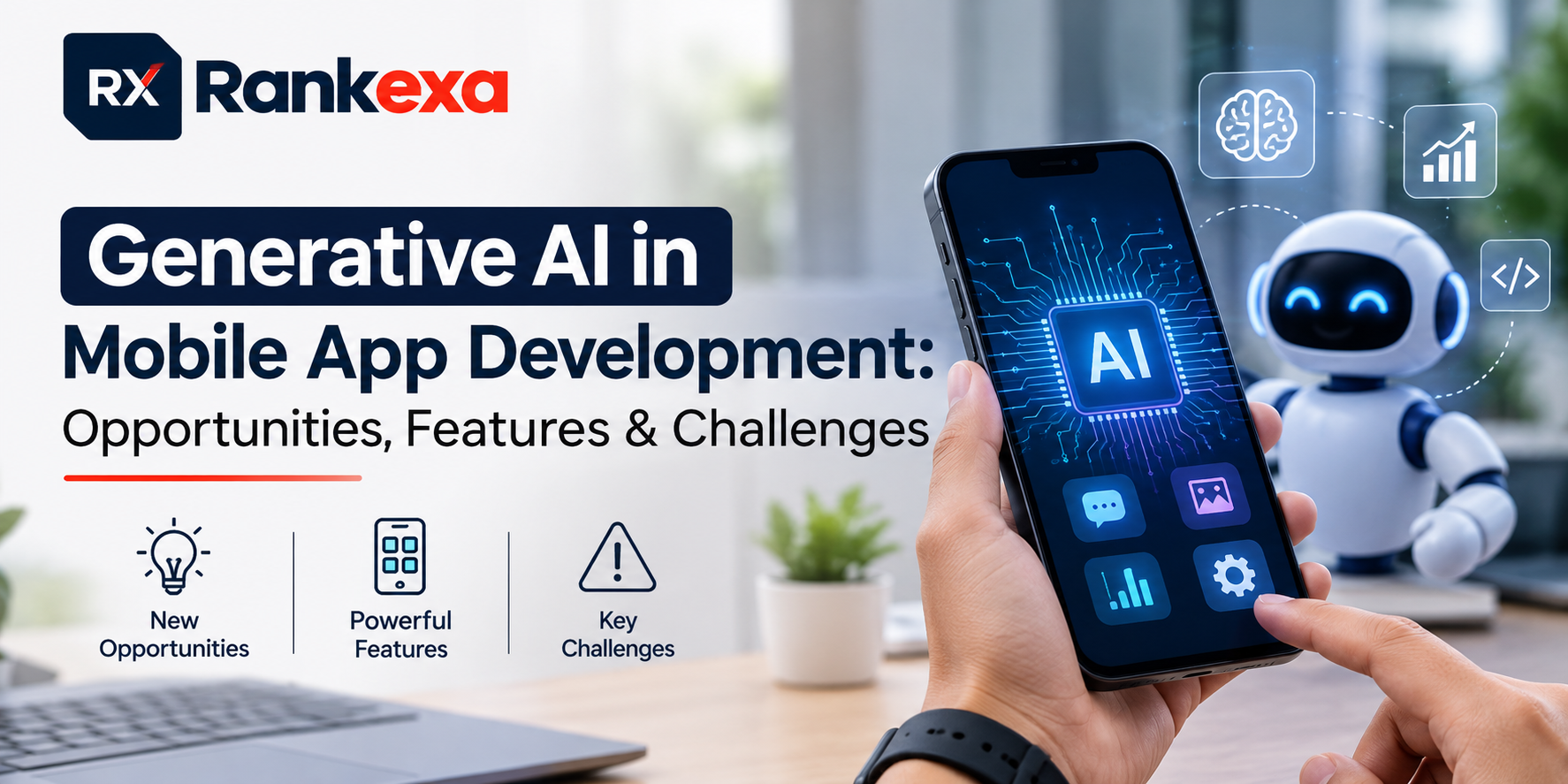
Generative AI is changing how businesses plan, develop, and improve mobile applications. From intelligent chatbots and personalized recommendations to automated content creation and AI-powered assistants, this technology is helping developers build smarter digital experiences. Generative AI in mobile app development allows applications to understand user requirements, generate relevant responses, automate repetitive tasks, and deliver more personalized interactions. Businesses across healthcare, education, e-commerce, banking, and entertainment are exploring AI-powered mobile solutions to improve customer engagement and operational efficiency.
However, successful implementation requires more than simply connecting an AI model to an application. Developers must consider data privacy, security, response accuracy, integration costs, and performance. Understanding its opportunities, features, benefits, and challenges helps businesses make informed technology decisions and create applications that meet changing customer expectations.
What Is Generative AI in Mobile App Development?
Generative AI in mobile app development refers to using artificial intelligence models that can create new content, understand natural language, and respond to user requests. These models can generate text, images, audio, code, and other outputs based on user instructions. When integrated into mobile applications, they make digital products more interactive, intelligent, and responsive.
How Generative AI Works in Mobile Applications
Generative AI models process information and generate responses based on patterns learned during training. Mobile applications communicate with these models through APIs or locally deployed AI systems.
- User Input Processing: The application receives text, voice commands, images, or other information from users.
- AI Model Analysis: The connected model interprets the request and identifies relevant information.
- Content Generation: The model creates an appropriate response, recommendation, or other output.
- Application Integration: The generated result appears within the mobile application's interface.
How Generative AI Is Transforming the Mobile App Development Industry
Generative AI is influencing the entire mobile app development process, from planning and coding to testing and user experience optimization. Development teams can use AI tools to accelerate selected tasks, explore new features, and improve application functionality. This transformation also allows businesses to develop more adaptive applications that respond to individual customer requirements and changing market demands.
Major Changes Driven by Generative AI
- Faster Development Workflows: AI coding assistants can help developers generate code suggestions, explain programming logic, and identify potential errors.
- Intelligent User Experiences: Applications can provide personalized responses instead of relying entirely on fixed menus and predefined interactions.
- Automated Support Systems: AI chatbots can answer common customer questions and assist users throughout their application journey.
- Improved Development Productivity: AI-powered tools can support documentation, test-case creation, prototyping, and repetitive development activities.
Top Opportunities of Generative AI in Mobile App Development
Generative AI creates opportunities for businesses to introduce innovative mobile features and improve existing digital services. Companies can use it to understand customer preferences, automate communication, and provide intelligent assistance. These opportunities are particularly valuable for organizations looking to improve application usability, streamline operations, and build competitive digital products.
Business Opportunities of Generative AI
- Personalized Customer Experiences: AI can analyze relevant user preferences and generate personalized recommendations, product suggestions, and content.
- Intelligent Virtual Assistants: Businesses can integrate conversational assistants that help users find information, complete tasks, and navigate applications.
- Automated Content Creation: Applications can generate product descriptions, summaries, marketing content, and other relevant material.
- Smarter Business Decisions: AI-powered analysis can help organizations identify patterns, understand customer behavior, and improve service delivery.
Key Features of Generative AI in Mobile Applications
Generative AI introduces several capabilities that make mobile applications more interactive and useful. Businesses can select features according to their industry, application objectives, target audience, and available resources. The right combination of AI capabilities can improve accessibility, simplify user interactions, and create more personalized experiences without making the application unnecessarily complicated.
Essential Generative AI Features
- Natural Language Processing: Understands human language and allows users to communicate with applications through natural conversations.
- AI Chatbots: Provides automated assistance, answers common questions, and supports customer interactions.
- Text and Image Generation: Creates written content, visual assets, and other digital materials based on user instructions.
- Personalized Recommendations: Suggests products, services, content, and relevant actions based on available user information.
Real-World Applications of Generative AI in Mobile Apps
Generative AI is becoming relevant across multiple industries because it can support different business requirements. From helping patients access general health information to improving online shopping experiences, AI-powered features can make applications more useful. However, businesses must consider industry regulations, information accuracy, and user privacy before introducing these capabilities.
Industry-Wise Applications of Generative AI
- Healthcare Applications: AI assistants can help users understand general health information, navigate healthcare services, and prepare questions for medical professionals. Medical decisions should remain under qualified professional supervision.
- E-Commerce Applications: Shopping applications can generate product descriptions, provide conversational product discovery, and recommend relevant items.
- Education Applications: Learning platforms can generate practice questions, explain educational concepts, and provide personalized learning assistance.
- Banking and FinTech Applications: AI can support customer service, explain financial products, and help users navigate banking features with appropriate security controls.
Benefits of Using Generative AI in Mobile App Development
Generative AI can provide measurable business value when implemented around clearly defined objectives. It helps development teams explore automation, improve customer communication, and introduce intelligent application features. Although results depend on implementation quality and user adoption, businesses can use AI to improve operational workflows and create more engaging mobile experiences.
Key Benefits for Businesses
- Better User Engagement: Personalized recommendations and conversational interfaces can encourage users to interact with applications more frequently.
- Reduced Development Effort: AI-assisted coding and documentation tools can help developers complete selected tasks more efficiently.
- Improved Customer Support: AI assistants can handle routine questions and provide support beyond traditional working hours.
- Business Process Automation: Repetitive activities such as content generation, information summarization, and basic support workflows can be automated.
Generative AI vs Traditional AI in Mobile App Development
Traditional AI and generative AI serve different purposes in mobile applications. Traditional AI focuses on prediction, classification, and pattern recognition, while generative AI creates new content based on user inputs. Choosing the right technology is essential for successful mobile app development services. A professional mobile app development service helps businesses integrate suitable AI solutions, improve user experiences, automate processes, and build smarter applications that support business growth.
| Comparison Factor | Traditional AI | Generative AI |
| Main purpose | Prediction and classification | Creating new content |
| User interaction | Mostly predefined outputs | Dynamic responses |
| Content generation | Limited | Text, images, audio and code |
| Common applications | Fraud detection and recommendations | Chatbots and content generation |
| Output | Predictions and classifications | Generated responses and media |
| Key consideration | Data quality and model accuracy | Accuracy, privacy and output validation |
How to Integrate Generative AI into a Mobile Application
Integrating generative AI requires a structured development approach. Businesses should first identify the problem they want to solve and then select suitable models, technologies, and integration methods. A well-planned implementation helps developers maintain application performance, protect user information, and ensure that AI features deliver practical value.
Steps to Integrate Generative AI
- Identify Business Requirements: Define the application's purpose, target audience, user problems, and expected AI functionality.
- Select the Right AI Model: Compare available models based on capabilities, pricing, performance, security, and integration requirements.
- Develop API Integration: Connect the mobile application with suitable AI services using secure backend architecture and appropriate authentication.
- Test and Optimize Features: Evaluate response accuracy, application speed, usability, security, and performance before deployment.
Generative AI in Android vs iOS App Development
Rankexa’s AI App Development help businesses integrate Generative AI into Android and iOS applications using advanced APIs, cloud-based AI models, and modern development frameworks. Our team focuses on application architecture, target audience, device compatibility, and business objectives to deliver effective solutions. We also prioritize platform-specific security, performance, scalability, and user experience to build reliable AI-powered mobile applications.
Platform-Wise AI Development Considerations
- Android Applications: Developers can integrate AI services through compatible APIs, Android development frameworks, and cloud-based infrastructure.
- iOS Applications: AI capabilities can be introduced using supported APIs, iOS frameworks, and secure backend services.
- On-Device AI: Suitable models can run directly on supported devices, helping reduce network dependency for selected tasks.
- Cross-Platform Development: Frameworks such as Flutter and React Native can support shared application experiences with carefully designed AI integrations.
How Much Does It Cost to Build a Generative AI Mobile App?
The cost of developing a generative AI mobile application depends on its features, complexity, platform, technology stack, and integration requirements. A basic AI chatbot application generally requires fewer resources than a sophisticated platform with multimodal AI, personalized recommendations, and enterprise-level security. Businesses should also consider ongoing model usage and maintenance expenses.
Factors Affecting AI App Development Costs
- Application Complexity: The number of screens, workflows, integrations, and advanced AI features affects development effort.
- AI Model Selection: Different AI models have different pricing structures, usage limits, and infrastructure requirements.
- Platform Requirements: Developing for Android, iOS, or both can influence project timelines and budgets.
- Maintenance and Scaling: API usage, security updates, infrastructure, monitoring, and model improvements contribute to long-term costs.
Future of Generative AI in Mobile App Development
The future of generative AI in mobile applications is expected to involve more personalized, conversational, and context-aware digital experiences. Improvements in multimodal models, on-device processing, and AI agents may create new opportunities for businesses. However, successful adoption will depend on responsible development, reliable outputs, user privacy, and practical business applications.
Emerging Generative AI Trends
- Multimodal AI Experiences: Applications will increasingly combine text, images, audio, and video interactions.
- On-Device AI Processing: More AI tasks may run directly on supported smartphones, improving responsiveness and reducing cloud dependency.
- AI Agents in Mobile Applications: AI agents may help users complete multi-step tasks through controlled and permission-based workflows.
- Hyper-Personalized Experiences: Applications may deliver more relevant content and recommendations using contextual information and user preferences.
How to Choose the Right Generative AI Mobile App Development Company
Choosing the right AI development partner is essential for building secure, scalable, and reliable applications. Rankexa helps businesses identify suitable AI solutions based on their goals and requirements. Before selecting a company, evaluate its technical expertise, project experience, development process, and ongoing support. A trusted partner like Rankexa focuses on practical AI technologies that deliver business value without unnecessary features.
Important Factors to Evaluate
- Technical Expertise: Check experience in Android, iOS, AI integration, APIs, and backend development.
- Previous Projects: Review relevant portfolios, case studies, and practical experience with AI-powered applications.
- Security Practices: Understand how the company handles data protection, authentication, access controls, and application security.
- Ongoing Support: Evaluate maintenance services, performance monitoring, updates, and future scalability.
Conclusion
Looking to build a smarter and more engaging mobile application with Generative AI? Connect with Rankexa to explore innovative AI solutions tailored to your business needs. Our team can help you identify the right AI features, choose suitable technologies, and develop scalable mobile applications that improve user experiences and support business growth.
Whether you are planning a new AI-powered app or upgrading an existing solution, we focus on practical strategies, secure implementation, and long-term performance. Get in touch with Rankexa today and take the next step towards building intelligent mobile applications.
Frequently Asked Questions
Q1. What Is Generative AI in Mobile App Development?
Ans. Generative AI in mobile app development is the use of AI models that generate content and responses based on user instructions. It can help applications create text, images, summaries, recommendations, and conversational experiences. Businesses use this technology to improve user interaction, automate selected tasks, and introduce intelligent features into Android and iOS applications.
Q2. How Is Generative AI Used in Mobile Applications?
Ans. Generative AI is used in mobile applications for chatbots, virtual assistants, content generation, personalized recommendations, and automated customer support. For example, an e-commerce application can use AI to answer product questions, while an education application can generate practice questions. These features help businesses create more interactive and personalized digital experiences.
Q3. What Are the Main Benefits of Generative AI in App Development?
Ans. The main benefits include improved user engagement, faster development workflows, automated customer support, personalized experiences, and better operational efficiency. Generative AI can also help developers with code suggestions, documentation, and testing activities. However, actual benefits depend on the application's purpose, implementation quality, model selection, and user adoption.
Q4. Which Generative AI Models Are Best for Mobile Apps?
Ans. Popular options include OpenAI models, Google Gemini, Anthropic Claude, and Meta Llama. The best choice depends on the required functionality, response quality, integration capabilities, pricing, privacy requirements, and deployment preferences. Businesses should test different models against real application use cases before selecting a technology for production.
Q5. How Much Does It Cost to Develop a Generative AI Mobile App?
Ans. The cost depends on application complexity, AI model selection, platform requirements, API integration, security, and development time. A simple AI-enabled application generally requires fewer resources than an advanced platform with multiple intelligent features. Businesses should also budget for API usage, cloud infrastructure, testing, maintenance, and future improvements.
Q6. Can Generative AI Build a Complete Mobile Application?
Ans. Generative AI can assist with code generation, interface ideas, documentation, testing, and development workflows. However, building a reliable production-ready mobile application still requires developers to manage architecture, integrations, security, testing, and deployment. AI is a development assistant rather than a complete replacement for professional software engineering.
Q7. Is Generative AI the Future of Mobile App Development?
Ans. Generative AI is likely to play an increasingly important role in mobile app development. Conversational interfaces, multimodal capabilities, personalized recommendations, and AI agents are creating new possibilities. Businesses that adopt these technologies responsibly may improve customer experiences and operational efficiency while maintaining appropriate privacy and security standards.
Q8. How Can Businesses Integrate Generative AI into Existing Mobile Apps?
Ans. Businesses can integrate generative AI into existing applications by identifying suitable use cases, selecting an appropriate model, and connecting it through secure APIs or backend services. Developers should then test response quality, data protection, performance, and usability. A gradual rollout helps organizations evaluate results and improve features based on actual user feedback.